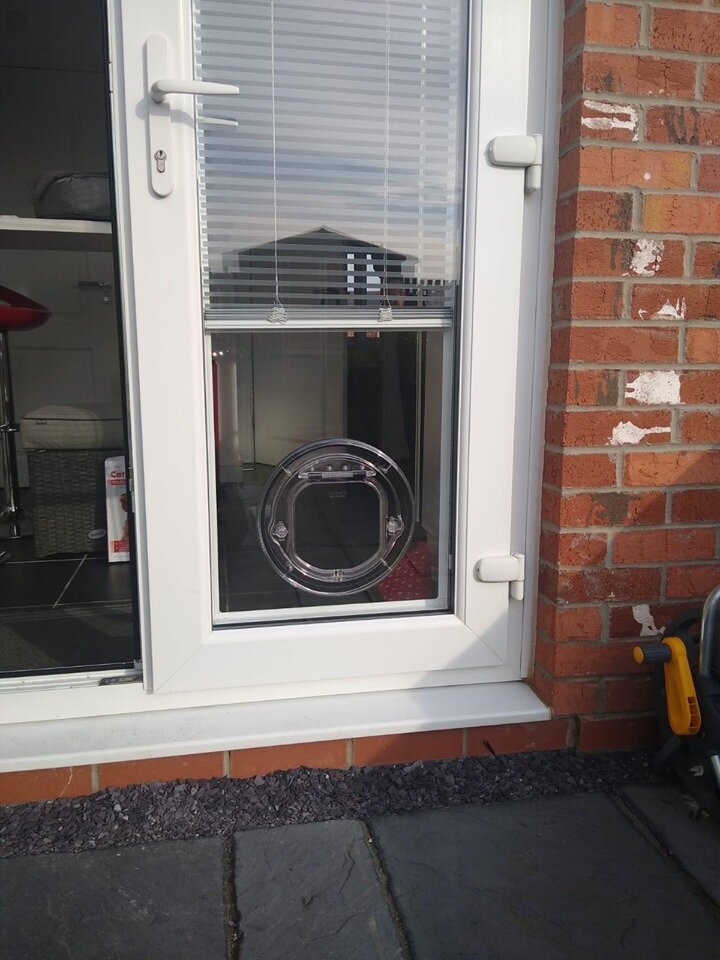
Why Toughened Glass Cannot Be Cut for a Cat Flap (And What We Do Instead)
The Physics in One Paragraph
Toughened (tempered) glass is heated to ~620 °C and then rapidly cooled by jets of cold air on both surfaces. The outer skin solidifies first while the core is still hot. As the core cools and tries to contract, the already-solid skin holds it under enormous compressive stress on the outside and tensile stress in the core.
That locked-in stress is what makes toughened glass 4–5× stronger than ordinary 'annealed' glass. But it also means any breach of the surface — a cut, a deep scratch, an edge nick — releases the stress instantly and the entire pane disintegrates into thousands of small cubes. It cannot be cut, drilled or notched after toughening. Full stop.
How to Tell If Your Glass is Toughened
Look for one of these:
• A small etched kitemark in the corner of the pane (often 'BS EN 12150' or a manufacturer logo)
• A 'T' or 'TEMP' marking on the spacer bar of a sealed unit
• The pane is in a door, patio door, bi-fold, or side panel beside a door — Building Regulations Approved Document K requires safety glass in these positions, so it's almost certainly toughened (or laminated)
• A faint roller-wave distortion visible when you look at a reflection at a low angle
If you have ordinary annealed glass in a door, it's either very old (pre-1991) or non-compliant. Either way, we wouldn't fit a cat flap into it — we'd swap it for a compliant toughened unit.
Laminated Glass — Same Story
Laminated glass (two panes bonded to a clear PVB interlayer) is sometimes specified for high-security doors and bi-folds. It can technically be cut, but only by specialist glaziers with a wet saw, and never once installed into a sealed double-glazed unit. For practical purposes, treat it the same as toughened — order a new pre-cut unit.
What We Actually Do
Every glass-door cat flap install follows the same workflow:
- Site visit. We measure the existing sealed unit precisely (width × height × thickness), record the spacer bar colour and the glass spec.
- Order new unit. A UK-based double-glazing factory makes a brand-new toughened (or laminated where required) sealed unit with the cat flap aperture pre-cut and edge-polished to the exact size of your chosen flap.
- Install day. We remove the beads holding your old unit, swap in the new pre-cut unit, re-fit the beads, and seat the cat flap into the factory-cut aperture with the manufacturer's gasket plus a low-modulus silicone bed.
- Test and hand over. Flap swings freely, magnetic catch firm, no draught, no water ingress.
Your original frame, door, hinges, locks and threshold are untouched. See the full process on our glass door fitting page.
Why This Is Better Than Cutting Anyway
Even if toughened glass *could* be cut on site, swapping the unit is still better:
• Factory cut is perfectly polished — no chipped or sharp edges
• The flap is sealed into purpose-made glass, not a workaround
• No glass dust or shards in your kitchen
• Lead time is short — most units arrive within 7–10 working days
• The new unit is brand new, so condensation and seal failures in the old unit are solved as a bonus
Does This Affect Building Regs or FENSA?
No. The new unit meets all current Building Regulations for safety glazing (Approved Document K) and thermal performance (Approved Document L). And because the frame is not replaced, the job is classed as a repair under FENSA's own definition and no FENSA certificate is required — see our FENSA guide.
Ready to go? Request a quote or check compatibility with our Will It Fit checker.